International standards
Worldwide access, European principles
Our vision for shaping the future data economy requires international standards for data spaces. Such standards are crucial for enabling sovereign and trustworthy data sharing, as demanded by European stakeholders, and are essential for ensuring interoperability across the global landscape.
Standardization – the key to interoperability
Data spaces can scale only when they rely on stable, widely accepted standards. International standards ensure interoperability, reduce technical barriers, and give organizations the confidence that their investments will remain future‑proof. They create the conditions for sovereign, secure, and trustworthy data sharing across industries and regions. Without standardization, data spaces risk fragmentation, higher costs, and limited adoption.
By aligning with globally recognized frameworks, organizations can:
- Secure long‑term ROI through interoperable solutions
- Lower integration and compliance costs
- Meet regulatory expectations such as the EU Data Act and Data Governance Act
- Accelerate adoption through shared practices and open‑source implementations
IDSA’s role in shaping interntional standards
The International Data Spaces Association (IDSA) provides a comprehensive soft infrastructure that defines the fundamental characteristics of data spaces: the IDS Reference Architecture Model (IDS‑RAM), the IDSA Rulebook, and the Dataspace Protocol (DSP). These resources ensure technical, semantic, organizational, and legal interoperability.
IDSA leads a consensus‑driven, globally connected community that co‑creates the standards enabling trustworthy data sharing. Through strategic collaboration with ISO, CEN/CENELEC, W3C, the European Commission, and the Eclipse Dataspace Working Group, IDSA actively contributes to the development and harmonization of international standards for data spaces.
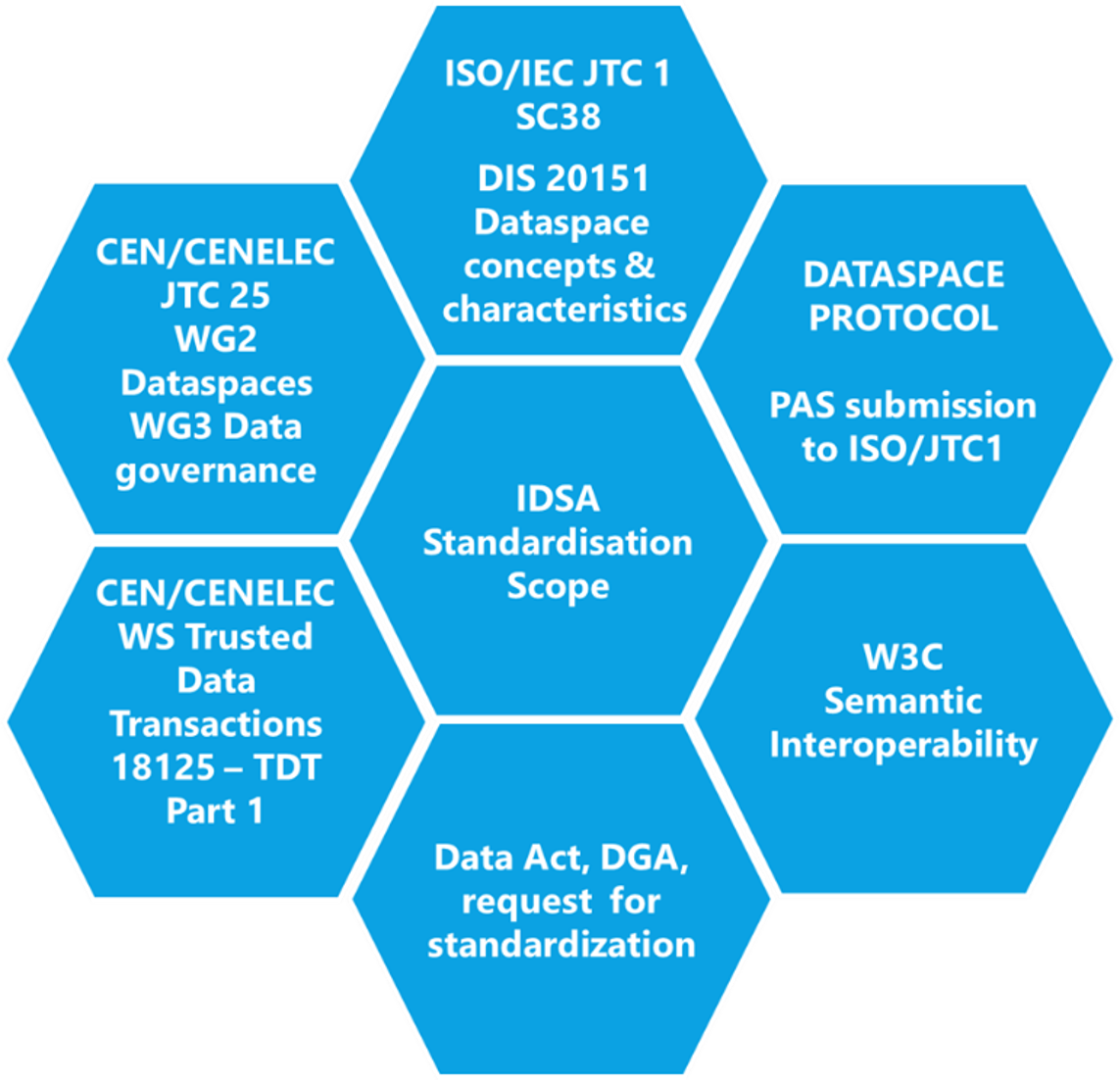
IDSA engagement in European and International Standardization bodies
ISO/IEC 20151 – Concepts and characteristics of data spaces
ISO/IEC 20151 builds on the IDSA Rulebook and defines essential characteristics of data spaces. Developed in ISO/IEC JTC 1 / SC 38, it is advancing towards the Draft International Standard (DIS) stage.
Dataspace Protocol (DSP) – PAS submission to ISO
The Dataspace Protocol defines how participants communicate securely and interoperably. Maintained by the Eclipse Dataspace Working Group, the DSP, its TCK, and compatible implementation are being prepared for ISO PAS submission.
W3C – Semantic interoperability
Together with W3C, IDSA addresses semantic interoperability challenges and co‑organizes workshops to advance consistent, machine‑interpretable data exchange across domains.
European Commission – Data Act & DGA standardization
CEN/CENELEC is developing standards to support the Data Act and the Data Governance Act, ensuring compliant, secure, and sovereign data sharing in the EU. This includes:
CWA 18125:2024 – Trusted Data Transactions: A pre‑standardization agreement defining secure, architecture‑independent data transaction principles.
JTC 25 WG2 & WG3
- WG2 works on trusted data transactions and harmonization within European data spaces
- WG3 focuses on data management, ontologies, and quality frameworks.
More

IDSA Rulebook
Learn how the IDSA Rulebook supports the development and operation of data spaces.

IDS RAM
Get insights into secure and trusted data sharing in business ecosystems.

Dataspace Protocol
Get an overview of the Dataspace Protocol
Any questions? Contact us!

Your contact person:
Silvia Castellvi
Director Research & Standardization
Become a member
Benefit from all current developments: Become a member of the International Data Spaces Association now!